



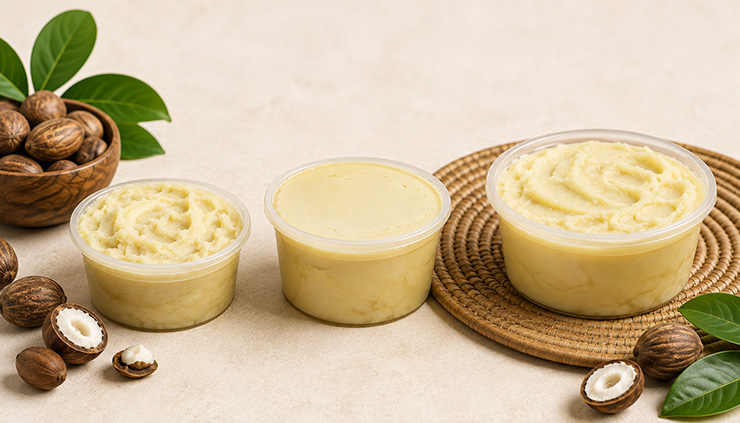
“Grade A” appears on almost every jar of shea butter sold online. It appears on jars that are genuinely cold-pressed and hand-filtered, and it appears on jars that have been bleached, deodorised, and cut with cheaper oils.
Nobody is stopping either from using the phrase.
That is the first thing worth understanding about shea butter grades: they describe a real and meaningful difference in how the butter was processed, and they are also almost entirely unpoliced.
Knowing what the grades actually mean, and what they cannot tell you, is the difference between buying shea butter that works and buying an expensive emollient.
This guide covers both grading systems in circulation, what separates unrefined from refined butter, what shea actually does on skin and hair, and the six checks that tell you what is in the jar regardless of what the label claims.
Jump to Section
What Shea Butter Is
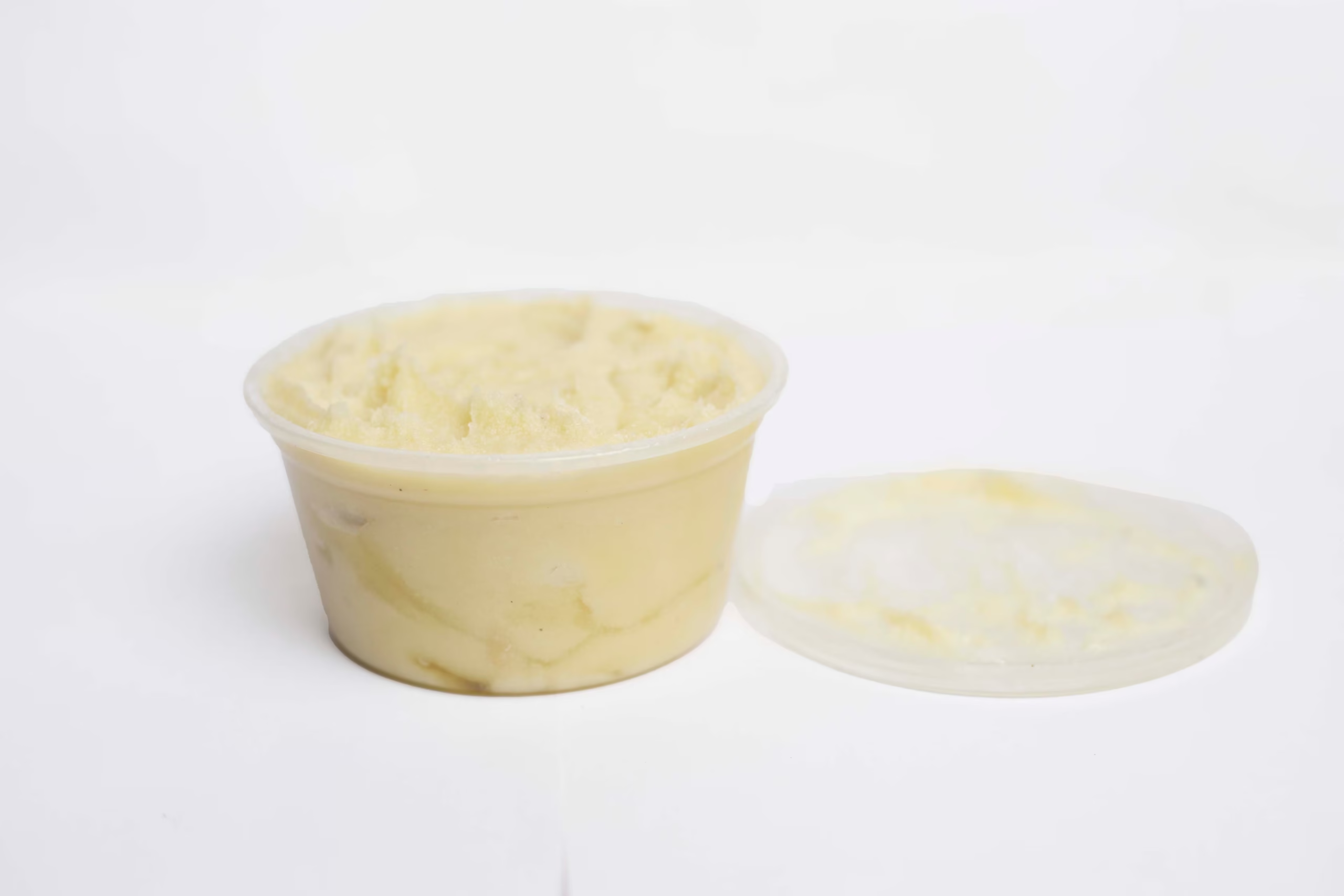
Shea butter is the fat pressed from the nut of the shea tree, Vitellaria paradoxa, which grows wild across a belt of savannah running from Senegal to Uganda.
On cosmetic labels, it appears under its INCI name, Butyrospermum parkii. In West Africa, it is called karité, the tree of life.
The traditional process has barely changed. Fallen fruit is gathered, the nuts removed and dried, then cracked, roasted, ground, and kneaded with water until the fat separates and rises.
It is skimmed, boiled, and left to set. The whole thing is done by hand, overwhelmingly by women’s cooperatives, and it produces butter that has never met a solvent or a bleaching agent.
Industrial processing takes the same starting material through a faster route: solvent extraction, bleaching clay, deodorising under steam.
It yields more butter, and the butter is uniformly white, entirely odourless, and much easier to blend into a mass-market lotion.
Those two routes are what the grading systems are trying to describe.
Shea Butter Grades: The Two Systems
Here is what most articles on this subject leave out: there are two different grading systems in use; they measure different things, and neither is legally enforced.
System one: the ASBI processing scale (A to F)
The American Shea Butter Institute grades shea from A to F based on how it was processed and how much of its bioactive fraction survives.
| Grade | What it means |
|---|---|
| A | Raw or unrefined. Cold-pressed, hand-filtered, no chemical treatment. Full nutrient profile intact. |
| B | Refined. Cleaner and milder, with a meaningfully reduced bioactive fraction. |
| C | Highly refined, typically solvent-extracted. Functions as a basic emollient and little else. |
| D | Lowest grade containing no contaminants. |
| F | Contains contaminants or processing residues. Not suitable for skincare. |
In practice, A, C, and F are the grades you will encounter in commercial supply. B and D describe intermediate states that are rarely sold under those labels.
What “bioactive fraction” actually measures
This is the part that gives the scale its meaning.
Most plant oils contain 1% or less of what chemists call unsaponifiable matter, the fraction that will not turn to soap under alkali. Shea butter contains between 5% and 17%.
That fraction holds the triterpene alcohols, cinnamic acid esters, and tocopherols that make shea behave differently from a standard moisturiser, and it is exactly what heavy refining reduces.
The ASBI uses this measurement as its grading criterion, requiring a bioactive fraction of roughly 4–6% for West African butter to qualify as premium Grade A.
Put plainly: refined shea butter is an emollient. Unrefined shea butter is an emollient plus everything else the tree puts in it.
System two: the colour labels
Separately, retailers describe shea by colour, and confusingly, these are also sometimes called grades:
- Ivory or white shea: naturally pale, unrefined, the most common export grade
- Yellow shea: coloured either naturally by the nuts or, in some cases, by added borututu root
- Grey shea: usually indicates a longer or less clean extraction
These describe appearance, not processing quality. Ivory and yellow shea can both be genuinely unrefined, and neither is inherently better than the other.
Why is the grade on the label not proof
Because no regulator enforces either system, “Grade A” is a supplier claim rather than a certification — unless that supplier has paid for ASBI lab analysis, which most have not. The phrase signals intent. It does not verify anything.
What carries more weight is a supplier who will tell you four things: the species, the country of origin, the extraction method, and that the ingredients list contains exactly one item.
Our raw shea butter is Grade A unrefined, single-ingredient Butyrospermum parkii, bought directly from West African producers rather than through an importer, which is why we can answer all four.
Unrefined vs Refined: What Changes
| Unrefined (Grade A) | Refined (Grade B–C) | |
|---|---|---|
| Colour | Ivory to pale yellow, varies by batch | Uniform bright white |
| Aroma | Mild, nutty, faintly smoky | None |
| Texture | Dense, can be slightly grainy | Smooth, uniform, waxy |
| Vitamins A and E | Retained | Substantially reduced |
| Unsaponifiable content | 5–17% | Lower after processing |
| Extraction | Cold-pressed, hand-filtered | Often solvent-extracted |
| Shelf life | 18–24 months | Longer |
| Best for | Skincare, haircare, DIY formulation | Mass-market and fragrance-led cosmetics |
The trade-off is real in both directions. Refined shea is easier to work with, blends invisibly, and lasts longer.
It is also doing less. Which one you want depends on whether you are buying shea for what it does or for how it behaves in a formula.
What Unrefined Shea Butter Does for Skin
Deep, lasting moisture
Shea works differently from a water-based lotion. It is occlusive, forming a barrier that slows water loss from the skin, and emollient, filling the gaps between skin cells and smoothing the surface.
That combination is why it outperforms lighter moisturisers on genuinely dry skin, hands, elbows, knees, cracked heels, and skin that has been through a hard winter.

One ingredient, nothing to react to
For anyone whose skin objects to fragrance, preservatives, or long ingredient lists, unrefined shea offers something rare: a single ingredient.
People with sensitive or eczema-prone skin often reach for it precisely because there is no fragrance to sting and no preservative to irritate.
Shea butter is a cosmetic, not a medicine. It does not treat skin conditions, and anyone managing a diagnosed condition should talk to a doctor rather than a product page.
Vitamins A and E, kept intact
Unrefined shea naturally contains both. Vitamin A supports skin elasticity and turnover; vitamin E is an antioxidant that helps defend against environmental stress.
Both are heat-sensitive, and both are substantially reduced by industrial refining. This is the practical argument for paying attention to grades at all.
Stretch marks and scarring
Shea has been used through pregnancy across West Africa for generations, applied to the belly, hips, and breasts as the skin stretches.
Evidence for fading marks that have already formed is thin, but as a way of keeping stretching skin supple and comfortable, it is well established and very widely used.
Everyday repair
Chapped lips. Split cuticles. Post-shave irritation. Skin after too much sun. Nappy area care. One jar covers a surprising amount of ground, which is part of why it has stayed a household staple rather than becoming a niche product.
What It Does for Hair
Unrefined African shea butter has been used on textured hair for centuries and remains one of the most effective natural sealants available.
As a sealant. In the LOC and LCO method, liquid, oil, cream, in either order, shea is the cream step. Applied over a water-based leave-in, it locks moisture into the strand instead of letting it evaporate.
On 4C hair, which loses moisture fastest, this is the difference between hair that stays soft for a day and hair that stays soft for four.
On dry, brittle ends. The oldest part of the hair takes the most damage. Working warmed shea through the last few inches reduces breakage during detangling and styling.
On a dry scalp. It soothes flaking and tightness without the silicone buildup that comes with many commercial scalp products.
Under protective styles. Braids, twists, cornrows, and wigs keep hair tucked away for weeks. Sealing before installing helps the hair underneath hold moisture through the whole stretch.
The mistake almost everyone makes: scooping it cold and packing it onto the hair. Applied that way, it sits on top, weighs the hair down, and looks greasy.
Warm a small amount between your palms for fifteen seconds until it turns clear and runs like oil, then work it through damp hair. Same product, completely different result.

Which Grade to Buy for DIY and Formulation
Soap makers, balm makers and small skincare brands buy shea by the kilo, and the grade question matters more here than anywhere else because it changes how the butter behaves in the formula, not just what it delivers on the skin.
Cold process soap. Typically 5–15% of the oil blend. Contributes conditioning properties and a creamy, stable lather. Grade A works well; the nutty scent survives saponification at higher inclusion rates.
Whipped body butter. Melt, cool until it just begins to set, then whip with a light carrier oil, sweet almond, jojoba, or fractionated coconut, until it aerates into a soft cream. Unrefined gives a better result here, since the point of a body butter is what it does on the skin.
Lip balms and salves. Roughly three parts shea to one part beeswax, adjusted for firmness and climate.
Hair butters and twist creams. Blend with castor oil for slip and hold, or coconut for a lighter finish.
Where refined might be the right call. If you are making a fragranced product and need the scent profile clean and refined, shea is the practical choice. That is the honest use case for it – not that it is better, but that it is neutral.
If you formulate regularly, our tiered pricing reaches 30% off at 100 units, and orders above 50kg get a consolidated shipping quote through our UK, Belgium, Germany, and USA warehouses. There is a bulk request form on the product page.
How to Use Shea Butter
- Scoop a pea-sized amount with a clean, dry spoon. Fingers introduce moisture, and moisture shortens shelf life.
- Warm it between your palms for ten to fifteen seconds, until it melts to a clear oil.
- Apply to damp skin, ideally straight after a shower while the skin is still holding water. This is when it absorbs best and seals most effectively.
- For hair, emulsify the same way and work through mid-lengths and ends, not the roots.
- For deep repair, apply thickly to heels or elbows at night and cover with socks or cotton gloves.
Less than you think. A 90g jar used as a targeted treatment typically lasts one person two to three months.
Storage
Cool, dry, sealed, below 25°C, out of direct sunlight. Use a spoon rather than fingers. Sealed and stored properly, unrefined shea keeps for 18 to 24 months.
If it melts in a warm room or in transit and then re-solidifies slowly, it can set grainy. That is a texture change, not spoilage; warm it in your palms, and the grain disappears completely.
Rancid shea, by contrast, smells sharp and sour rather than nutty. That one you throw away.
Six Checks That Beat the Label
In order of usefulness:
- Read the ingredients. It should say one thing: shea butter, or Butyrospermum parkii. A list is a blend.
- Look at the colour. Ivory, cream, or pale yellow, varying between batches. Uniform bright white is a refining tell.
- Smell it. Mild, nutty, slightly smoky. Odourless means deodorised. Perfumed means something was added.
- Feel it. Dense and firm, softening at body heat. Slippery straight from the jar suggests blending with cheaper oils.
- Check for an origin. A supplier who names the country and the extraction method has a supply chain. One who says only “premium quality” may not.
- Sanity-check the price. Genuine unrefined shea is not the cheapest thing on the shelf, and butter priced far below market has usually been cut with something.
Notice that not one of these checks is “read the grade on the label.” That is the point.
Frequently Asked Questions
What are the shea butter grades?
The American Shea Butter Institute grades shea from A to F by processing method and surviving bioactive content. Grade A is unrefined and cold-pressed; C is highly refined; F contains contaminants. Separately, retailers use colour labels, ivory, yellow, and grey, which describe appearance rather than processing.
Is Grade A shea butter an official certification?
Not in any legally enforced sense. The ASBI operates a grading scale and will lab-test butter against it, but most suppliers using the phrase have not been through that process. Treat it as a claim and look for ingredient and origin transparency to back it up.
What is the difference between Grade A and Grade B shea butter?
Grade A is unrefined, cold-pressed, and hand-filtered with its full nutrient profile intact. Grade B has been refined, making it milder and cleaner but with a meaningfully reduced bioactive fraction.
Is yellow shea butter a different grade from ivory?
No. Colour and processing grade are separate things. Both ivory and yellow shea can be genuinely unrefined. The shade depends on the nuts, the region, and, in some cases, added borututu root.
Is raw shea butter the same as unrefined shea butter?
Yes. The terms are used interchangeably, and both describe butter that has not been bleached, deodorised or solvent-extracted.
Which grade should I buy for skincare?
Grade A unrefined, in almost every case. The compounds that make shea worth using are the ones that refining removes.
Why does unrefined shea butter smell nutty?
Because nothing has been done to remove the smell. The aroma comes from compounds naturally present in the nut and fades within a few minutes of application.
Can I use shea butter on my face?
Yes, though it is rich. Most people use a thin, palm-warmed layer at night. If your skin is acne-prone, patch test along the jawline for a few days first; heavier butters do not suit every skin type.
Can I eat shea butter?
It is used as a cooking fat in parts of West Africa. That said, butter sold for cosmetic use is not produced or certified to food standards, so do not assume a cosmetic jar is edible.
How much should good shea butter cost?
More than refined, less than a branded body cream. Anything dramatically cheaper than the market has usually been refined, blended, or both.
Where to Buy Grade A Shea Butter
We source ours directly from West African producers who process it by hand, which means no importer sits between the cooperative and the jar.
One ingredient, Grade A unrefined, no dilution and no refining step, with worldwide delivery in 2 to 7 days from our UK, Belgium, Germany, and USA warehouses.
Or browse the rest of our African beauty and wellness range, including Chebe powder, baobab oil and cocoa butter.