






Mancala is one of the oldest games still played daily anywhere in the world, and a hand-carved wooden board is one of the few gifts that works as an object, an activity, and a piece of heritage at the same time. It sits on a coffee table looking like art, and then somebody opens it, and you lose an hour.
This guide covers the practical part most gift articles skip: which board size suits which recipient, what a real handmade board weighs, what it costs, how the game is actually played, and what to check before you buy.
Jump to section:
Compare the two boards
| African Handmade Wooden Mancala Board | Square Mancala African Game Board | |
|---|---|---|
| Price | $67.00 | $50.00 |
| Size | 43.5 × 7.5 × 5.5 cm | 16 × 9 × 9 cm |
| Weight | 985 g | 190 g |
| Playing pieces | Included | Included |
| Format | Full-size, folds/bends for storage | Compact carved block |
| Also known as | Awélé, Oware, Manakala | — |
| Artisan | Chance | Mouhamadou Fadil |
| Best for | Family game nights, a gift that gets used | Desks, shelves, travel, smaller budgets |
Which board suits your recipient
For a family with children. Go for the 43.5 cm folding board. The pits are large enough for small hands, the seeds come with it, and the rules are simple enough that a six-year-old can play a real game against an adult without anyone pretending. Mancala teaches counting, planning ahead, and losing gracefully — which is more than most board games manage.
For a parent or grandparent in the diaspora. This is the board people get emotional about. If they grew up playing awalé, ayo, omweso, or bao, the folding board is the closest thing to what they remember, and it plays properly rather than sitting on a shelf.
For someone who travels. The square board weighs 190 g and fits in a backpack pocket. It is the one to send if the recipient is in student housing, moves often, or wants a game for the plane.
For a housewarming or an office. Either works, but the compact board is the more natural desk object, and the folding board makes a better coffee-table centrepiece. Both pair well with our wooden sculptures and decorative baskets if you are building a themed gift.
For a collector of African art. Look at the carving rather than the price. Every board is cut by hand, so grain, tone, and depth of the pits vary between pieces. The photos on each product page show the actual stock.
What to check before buying any wooden Mancala board
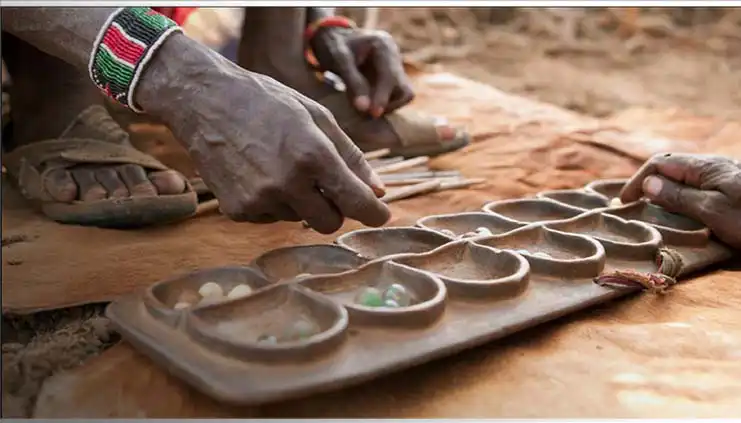
- Are the seeds included? A board without playing pieces is not a game yet. Our folding board ships with its pieces; if you buy elsewhere, confirm this before checkout.
- Pit count. A standard Mancala board has two rows of six pits. Some boards add two larger end wells, called stores. Both are playable — they just use slightly different rules (see below).
- Weight and international shipping. Solid hardwood is heavy, and weight drives the courier cost far more than size does. At 985 g and 190 g, respectively, both of our boards ship as ordinary parcels rather than freight.
- Finish. Look for a board sealed with natural oil rather than heavy varnish. Oil ages well and can be refreshed; thick lacquer chips and cannot be repaired at home.
- Folding or solid. Folding boards store flat and travel well. Solid boards feel more substantial in play and display better.
- Who made it? Every board on BaobabMart lists the artisan or seller by name on the product page. That traceability is the point; you are buying from a person, not a factory line.
How to play Mancala
Most African boards are played as Oware (also written awélé or ayo). Here are the rules in full; one read is enough to start.
Setup. Two rows of six pits face each other. Each player owns the row closest to them. Place four seeds in each of the twelve pits, 48 in total.
Sowing. On your turn, pick up all the seeds from any one pit on your own side. Drop them one at a time into each following pit, moving counter-clockwise around the board. If you are holding twelve or more seeds and lap the whole board, skip the pit you started from.
Capturing. If your last seed lands in a pit on your opponent’s side and brings that pit to exactly two or three seeds, you capture its contents. If the pit immediately before it — also on their side — now holds two or three, you capture that too, and so on backwards until the chain breaks.
The feeding rule. You may not make a move that leaves your opponent with no seeds at all. If they have none, you must play a move that gives them at least one. If no such move exists, you capture the remaining seeds on your own side, and the game ends.
Winning. There are 48 seeds, so the first player to capture 25 wins. Capturing 24 each is a draw. If the game loops with too few seeds to make progress, both players take the seeds on their own side and count up.
If your board has two end wells (the Kalah variant), sow into your own store but skip your opponent’s. Landing your last seed in your own store gives you another turn. Landing it in an empty pit on your own side captures that seed plus everything directly opposite. The player with the most seeds when one side empties wins.
Start with a few practice games before playing for real. The first strategy anyone discovers is holding seeds back to build a large pit; the second is starving your opponent’s row so they have nothing to sow. Both are legal, and both are how the game gets interesting.
Caring for a hand-carved board
Wipe it with a dry, soft cloth. Keep it out of direct sunlight and away from radiators, since dry heat is what cracks carved wood. Every few months, rub in a small amount of food-safe mineral oil or natural wood oil and let it sit overnight. Never soak the board or clean it with detergent; the pits hold water and the grain will lift.
Treated this way, a hardwood board outlives the person who gave it. Many households in West Africa are still playing on boards their grandparents used.
Ordering, shipping and gifting
We ship worldwide from warehouses in the UK, Belgium, and the United States, using DHL, FedEx, UPS, USPS and Royal Mail depending on your destination. US orders are dispatched the same day. A Dubai warehouse for Middle Eastern and Asian customers is scheduled to open by the end of 2026; until then, those orders are dispatched from Cameroon, the UK, or the US.
Prices are displayed in USD, EUR, GBP, CAD, JPY, AUD, AED, and ZAR — use the currency switcher at the top of any page. Delivery windows for your country are listed on our shipping and delivery times page.
Buying several boards? Retailers, cultural centres and schools can request a quote through our bulk purchase page. Wholesale pricing and freight quotes apply to consignments above 50 kg.
If the board is a gift, order early enough to leave room for customs clearance, and consider adding a printed copy of the rules above. Most recipients have heard of Mancala but have never been taught to play.
Frequently asked questions
How much does a real handmade wooden Mancala board cost?
Between $50 and $67 at BaobabMart, depending on size and whether playing pieces are included. Mass-produced boards sell for less, but they are machine-cut from softwood or MDF and will not last.
Is Mancala suitable for children?
Yes. Most children can play from about six years old. The rules take two minutes to learn, and the counting and planning involved make it genuinely useful practice.
What is the difference between Mancala, Oware, and awélé?
Mancala is the family name for hundreds of sowing games played across Africa, Asia, and the Caribbean. Oware — spelled awélé, ayo, or awale depending on the region — is the best-known West African version, and it is what our boards are made for.
Do the boards come with seeds or stones?
The folding board at $67 includes its playing pieces. If pieces are ever lost, any small uniform objects work: dried beans, pebbles, glass beads, or cowrie shells.
Can I buy a Mancala board in bulk for a shop or school?
Yes. Submit the bulk request form on the product page or through our bulk purchase page, and we will quote you, including freight.
How long does delivery take?
It depends on your country and which warehouse serves it. US orders dispatch the same day; see our delivery times page for current estimates by destination.
How do I keep the wood from cracking?
Keep it out of direct sun and dry heat, and oil it lightly two or three times a year.
Ready to choose one?
If you want the board to be played, take the folding Mancala board with playing pieces at $67. If you want something compact, portable, or lower-cost, take the square carved board at $50.
Browse everything in traditional game boards, or read the history of African mancala boards if you want the background before you buy.